

Artificial Intelligence is moving exponentially high in today’s time. It has moved from experimental tech to a core element for online retailers. Today, AI has become an integral part of the e-commerce landscape. It’s like less than three years after ChatGPT’s groundbreaking release, which has sparked the widespread adoption of generative AI, not to mention that it is not difficult to find an online merchant that is not using AI.
Why AI in E-commerce?
AI has been reshaping the way online businesses operate and streamline processes, while working to enhance the overall customer experience, driving sustainable growth even at times when resources are limited.
AI is everywhere, from basic chatbots to advanced agentic commerce, from predictive analysis to sophisticated fraud detection activities. E-commerce has been continuously positioning itself to benefit from AI-backed solutions.
This article aims to elucidate knowledge on how AI is transforming the e-commerce business and its solutions. Here we showcase real-world applications of AI, and address key challenges that online businesses face.We also deliver a forward-looking perspective on the future of AI in e-commerce, where intelligent, adaptive solutions are expected to redefine customer engagement and operational efficiency.
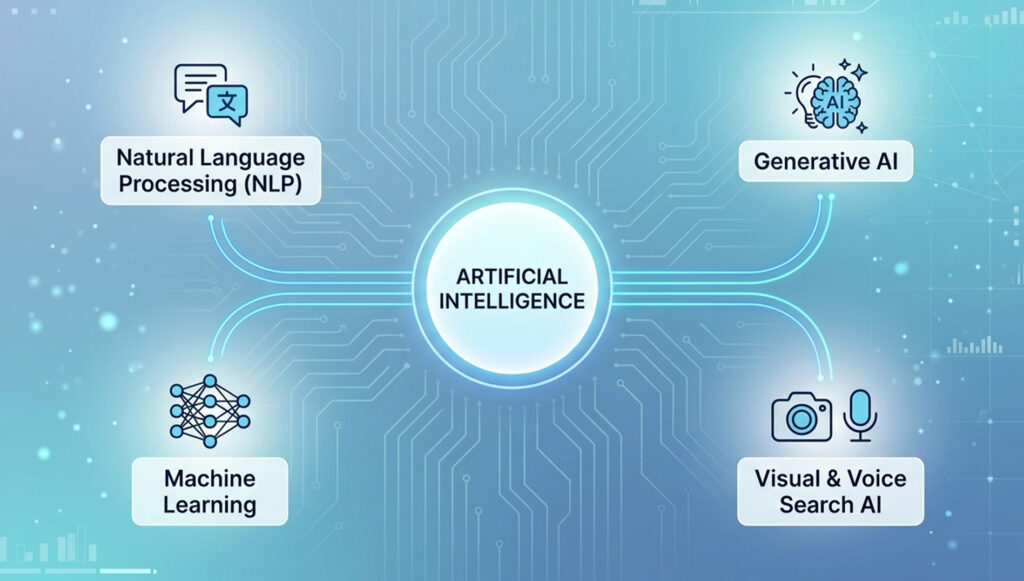
Types of AI Technologies for E-commerce
The role of AI in e-commerce is not limited to but extends beyond chatbots and recommendations, as it involves a wide range of technology applications that assist businesses in scaling and automating their operations. So, understanding different types of AI technologies in ecommerce allows brands and businesses to imagine a clear picture of how AI technologies work for business and how they can be applied to streamline their process of customer journey.
- Natural Language Processing (NLP)
Natural Language Processing is a type of machine learning and AI that works with computers to understand human language. So while leveraging NLP for ecommerce search, it enables ecommerce search engines to accurately understand what customers are effectively looking for and deliver search results that better match the products customers search for.
- Generative AI
Generative AI automatically helps product descriptions, marketing copies, and visuals for an e-commerce business. It helps reduce the manual workload by ensuring efficiency, consistency, and speed, as it aids in enhancing personalization by generating content tailored to customers’ wants.
- Machine learning
Machine learning (ML) enables e-commerce platforms to improve the results they deliver over time by learning what works best. For example, any item can be offered with cross-sells at the check-out stage. A snowboard buyer could be offered wax, special boots, socks, a helmet, etc. By tracking successes, ecommerce platforms equipped with ML learn over time which of these items is most likely to result in a purchase, and then act accordingly.
- Visual and Voice search AI
Buyers are increasingly preferring to conduct their search through voice or by visuals, such as using images or voice commands. Visual AI allows users to upload the photos instantly or reference images to find a product similar to what they have been looking for, while voice makes it easy for shoppers to avoid any typos and enables hands–free shopping. These technologies improve customer experience and open new avenues for product discovery.
Benefits of AI in e-commerce
Implementing AI in e-commerce brings various benefits to online businesses. Let’s understand each of them briefly.
- Improved efficiency
AI is used to streamline routine tasks like product recommendations, inventory forecasting, and customer support, so this strategically frees up the team to focus on more tedious and creative work, and according to McKinsey, generative AI helps contribute up to $4.4 trillion in annual productivity gains worldwide.
- Smarter data-driven decision making
AI allows retailers and businesses the ability to analyze customer behavior at a deeper level. So with advanced algorithms, businesses can identify the buying patterns, predict the level of demand, and create highly creative campaigns.
It leads to more relevant product suggestions, optimizes assortment planning, and AI-driven customer experience improves with time, increasing both engagement and loyalty.
- Reduce Operational Cost
AI implementation can help reduce operational costs as AI tools cut the expenses by automating customer support, detecting fraud in real time, and dynamically adjusting the process accordingly. Research reflects that companies that use AI-driven strategies have reduced their average operational cost by 8 to 10% while delivering more value to customers.
- Enhanced customer experience
AI and AI data-driven strategies bring a transformative impact on customer satisfaction levels. Through the application of voice and visual AI, every interaction feels relevant and efficient, so by providing product discovery, minimizing friction, and offering constant support, businesses showcase how AI improved the online shopping experience in ways that keep shoppers coming back.
- Streamlined sales process
AI can analyse customer data to identify high-potential leads and optimise the sales funnel. By predicting which prospects are most likely to convert, sales teams can prioritise their efforts and tailor their approaches accordingly. AI-powered chatbots can also handle initial inquiries and qualify leads, ensuring that human sales representatives focus on the most promising opportunities.
Example: AI-powered systems can send a reminder if a customer leaves items in their cart, often with a discount to encourage completion, boosting conversion rates.
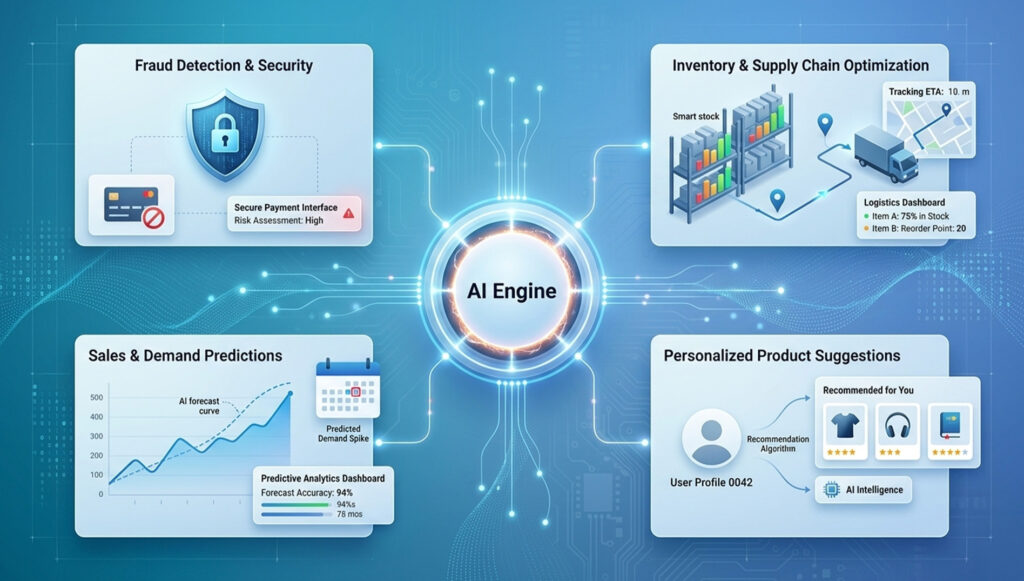
How is AI transforming e-commerce?
- Fraud Detection and Security
With the rising level of online scams, transaction fraud prevention and security management are top priorities. AI systems assist in detecting suspicious activities in real time, like unusual payment patterns or account takeovers, reducing financial risk for both business and customers. This, in turn, strengthens trust, which is vital for e-commerce success.
- Inventory and supply chain optimization
AI helps enable predictive demand forecasting, helping businesses to stock the right quantity of products at the right time. From warehouse automation to last-mile delivery optimization, AI reduces waste, minimizes stockouts, and enhances supply chain efficiency.
- Sales and demand predictions
AI algorithms can analyse historical sales data, market trends, and external factors to predict future product demand. By accurately forecasting sales, businesses can optimise inventory management, avoid stockouts or overstocking, and make informed decisions about production and marketing strategies.
- Personalised product suggestions
AI algorithms analyse customer data, such as browsing history, purchase history, and demographic information, to provide personalised product recommendations. By suggesting items that are highly relevant to each shopper, businesses can increase average order value and customer satisfaction.
How to bring AI in E-commerce – Implementation Strategies & Best Practices
If you are an ecommerce brand or business, you must invest in AI as it is worth your time, and get acquainted with the best practices and successfully deploy it in your business.
Here’s how you can do that
Define your goals and objectives: Work with your team to identify your primary goals for using AI in eCommerce. These will help justify any investment and be important to track once you’ve added new AI to your workflows.
- Understand and study the requirements
When you have decided to implement AI for your ecommerce business, you should first understand the basic requirements and implementation techniques. Apart from costs and time, you should study the concerns of implementing AI. For example, if you’re using AI to collect and analyse customer data, you may be required to update your company’s privacy policy.
- Prioritise tools that will enhance business efficiency and customer experience
There are artificial intelligence solutions for stock control, manufacturing, customer support, marketing, the list goes on.
Focus on the tools that will bring the most value to your company. This usually means looking for solutions that ensure you deliver excellent customer service while streamlining your workflows to bring costs down.
- Monitor and audit your AI-powered workflows
Carefully monitor how effectively AI is enhancing workflows and whether it is helping to achieve your desired outcomes.
In many instances, AI will be able to improve itself over time. With a little input from real humans, it can be shaped and guided to more closely meet your needs as time goes on and more data has been collected
Case Study of AI in E-commerce
- Sephora
Sephora is the global leader in the beauty industry. Sephora uses AI in its e-commerce store to elevate customer experience and drive sales, so by adopting innovative technologies like augmented reality and machine learning, Sephora has successfully blended digital convenience with personalized shopping.
Sephora’s virtual assistant, powered by AI and AR, helps shoppers try makeup products virtually, which acts as an interactive feature to help customers choose their perfect shade of product.
Sephora has also enabled personalized product recommendations. Here, Sephora helps suggest beauty products in the form of personalization that shows the role of AI in e-commerce for creating a unique customer journey.
Sephora’s chatbot offers real-time beauty advice and product guidance, showcasing a practical example of how AI is used in e-commerce to improve customer service.
So with AR, try-ons, and personalised recommendations, Sephora has significantly improved its customer satisfaction rating, plus AI–driven recommendations have led to an increase in conversion rates. Thus, it helps prove that AI in commerce gives shoppers confidence in purchasing and helps brands achieve measurable growth.
- Zara
Zara is one of the most prominent e-commerce stores when it comes to fashion, beauty, and everything in luxury. Zara uses AI to optimise their inventory management system. With the incorporation of AI for inventory management, Zara analyses sales data and trends, allowing Zara to produce garments in smaller or more agile batches.
The role of AI in Zara doesn’t end here, they use an AI personalised shopping experience for customers to analyse customer preferences and purchase history. Zara also features a Zara virtual try-on that helps improve the overall shopping experience of the user.
- Alibaba
Alibaba is one of the leading e-commerce platforms; it showcases the transformative power of AI in e-commerce through its advanced image recognition technology. Users can upload a photo of a product they like, and the system will instantly display the products that are similar items available for purchase. Here, Aliabba leverages AI-powered chatbots and virtual assistants to provide continued services, as these bots handle the routine tasks efficiently, allowing humans to focus more on complex issues.
- eBay
eBay has integrated AI across its multiple stages to strengthen its customer experiences and operational efficiency. One of their key innovations lies in implementing a dynamic pricing system where AI adjusts the product prices in real time to analyze the supply and demand while studying historical sales data trends. eBay has also invested in AI–driven fraud detection technology to identify fake listings, suspicious payment activity, and other fraud behaviours.
The success stories of Sephora, Zara, and global marketplaces like Alibaba and eBay showcase that the role of AI in e-commerce is no longer optional, but it’s a requirement for measurable growth, whether it is simply in the journey, delivering hyper-personalized recommendations, or using AI-powered tools to improve brand loyalty towards customers and revenue.
Future of AI in E-Commerce
The future of AI in e-commerce promises to transform and reshape the e-commerce business. It is working to reshape the overall online shopping landscape with innovative solutions such as personalisation and automation.
As many e-commerce businesses are already adopting emerging AI trends in their workflow system, the next digital era will be more defined, intelligent, and adaptive when it comes to understanding the future of AI.
AI will provide a real-time adaptive customer experience where content like offers and product display will shift dynamically based on the user’s behavior. Whether it’s adjusting price strategies by showcasing trending products, the future of adaptive AI will ensure that businesses will stay competitive and relevant every moment.
The future of AI will see a trend of voice and visual search adoption as shoppers will increasingly use the AI–driven tools for faster, hands-free product discovery. Further, there will be a rise of autonomous AI agents who will transform how businesses manage operations and inventories.
Why Choose End-to-End for AI in E-commerce?
For online businesses, the true advantage lies in integrating AI within commerce services, and for that, we at End-to-End Ecommerce assist you with your e-commerce solutions.
By combining AI-driven tools with comprehensive e-commerce solutions, businesses can unlock seamless automation, accelerate growth, and deliver consistently superior customer experiences.
With AI and e-commerce services working together, businesses can gain a competitive edge, scale smarter, and future-proof their digital presence in an increasingly dynamic marketplace.
FAQ’s
How is AI used in E-commerce?
AI is used in e-commerce to personalize the shopping experience, improve product discovery, improve search accuracy, and automate customer service while managing inventories and supply chains. Further incorporation of AI in e-commerce extends to fraud detection, ensuring efficiency and customer engagement.
What are the benefits of AI in e-commerce?
Benefits of AI in e-commerce include better customer experience, higher efficiency, cost reduction, etc, for better insights, refer to the blog above.
How to use AI in e-commerce?
To use AI in e-commerce, you must understand your business and what your objectives are with AI, so by aligning your business goals with AI strategies, you can maximise efficiency and elevate your AI–driven experience in e-commerce.
Why is AI important for the future of e-commerce?
AI is crucial for the future of e-commerce as it offers personalized customer experiences, automation, and real-time adaptive solutions that keep businesses competitive, relevant, and efficient in a rapidly evolving digital landscape.
What types of AI technologies are utilized in e-commerce?
E-commerce utilizes various AI technologies including Natural Language Processing for understanding human language, Generative AI for creating content, Machine Learning for predictive insights, and Visual and Voice Search AI for enhanced product discovery.
What are the main advantages of integrating AI into online retail?
Integrating AI in online retail improves efficiency, enables smarter data-driven decision making, reduces operational costs, enhances customer experience, and streamlines sales processes, thereby fostering growth and customer loyalty.
How can a business successfully implement AI solutions?
A business can successfully implement AI by clearly defining goals, understanding technical requirements, prioritizing tools that enhance efficiency and customer experience, and continuously monitoring and refining AI workflows based on performance data.
Can you provide examples of AI applications in leading e-commerce companies?
Yes, Sephora uses AI and AR for virtual try-ons and personalized recommendations, Zara employs AI for inventory management and personalized shopping, Alibaba utilizes AI for image recognition and customer service, and eBay integrates AI for dynamic pricing and fraud detection.
The role of AI in e-commerce has proven to be transformative and is reshaping the overall e-commerce landscape. It enables a personalised shopping experience, allows predictive analytics, fraud detection, and many more things.
Adopting AI is no longer an option but essential to stay competitive and future-ready, so businesses can embrace AI solutions to enhance their efficiency to deliver accurate results and improve customer satisfaction to drive long-term growth.
At End to End Ecommerce, we specialize in helping ecommerce businesses incorporate AI–driven solutions in every stage of their journey, from customer acquisition and engagement to logistics and revenue optimization.
Whether you want to implement AI chatbots, personalize product recommendations, or explore immersive AI-powered shopping experiences, our tailored strategies ensure you stay ahead of the curve.
Ready to transform your business with AI?
Connect with End2End Ecommerce today and explore how our solutions can future-proof your brand in the digital marketplace.